To overcome the limitations of managing over 40 complex Excel workbooks, Integria Healthcare partnered with QMetrix to implement Workday Adaptive Planning. This transition has replaced tedious manual processes with a streamlined, global platform that enables real-time collaboration, rolling forecasts, and more agile scenario planning.

With a history that spans 70 years of science and research into herbal remedies, Integria Healthcare inspires people to live better lives through natural healthcare. They bring together the best names in natural medicine to deliver a suite of herbal, nutritional and complementary healthcare products supported by scientific and traditional evidence.
Integria’s brands include Mediherb, Eagle, Thompson’s, Thursday Plantation and Eureka.

Integria’s challenge: Fragmented data and tedious reporting
Integria Healthcare had a situation that would be familiar to many finance teams and those involved in the budgeting process: They had 40+ budget workbooks in Excel, with many people involved in the process.
With just payroll alone, they would have someone from HR and someone from finance to manage all the data.
Everything was built and managed in one file. The output would then get manipulated and put in another file. If a change was made, someone had to update the change across all relevant Excel sheets. Even with team members skilled in Excel, there were still errors. Furthermore, people could not easily change data especially if it was sensitive.
The whole budgeting, planning and forecasting process was tedious and took a lot of time. The Chief Financial Officer at Integria recognised that things could be done better, and set out to transform the way the finance function operated.
Integria needed a solution that could:
- Improve the way they budget, forecast and report – making it more efficient and collaborative
- Support and report across multiple dimensions, including numerous cost centres with complexities around legal entity, geography and departments
- Seamlessly integrate with source systems to support planning and reporting activities.
- Easily handle multiple currencies given their international operations.
Solution: A single source of truth for global teams
A 3-way integrated model
Working with QMetrix, Integria chose Workday Adaptive Planning, and broke down the project into manageable phases where tangible process and value could be delivered incrementally throughout.

Integria started with building the Profit and Loss sheet, followed by Balance Sheet and Cashflow.
This was all integrated into a 3-way model whereby they could model out the various schedules that impact balance sheet and cashflow. This enabled them to forecast their cash position in the next 6 – 12 months and potentially further out.
Being able to forecast out enabled them to manage their resources better – where they are spending their money, what capital purchases they should and can make, and when.

Collaborative planning on a dynamic platform
Joanna Woodbridge, Financial Controller who manages Workday Adaptive Planning at Integria Healthcare, says, “Our team is global and the real benefit in Workday Adaptive Planning is being able to collaboratively work through the budget and forecast, and immediately see the impact.”
If a new headcount or sales forecast is added, this change is reflected all the way through without having to fix up multiple spreadsheets. Line managers and executive management can see this reflection immediately where relevant.

“I like that things in Workday Adaptive Planning are dynamic. If I move where a cost centre sits, under the level structure, then that dynamically moves. That’s not something that always happens in an ERP.”
– Joanna Woodbridge, Financial Controller
The black box of finance – replaced with transparency
Instead of having the “black box of finance” and waiting for spreadsheets and static reports to be shared around, authorised users can click on actuals and drill down to transactions.
They can see how they are tracking across each cost centre and GL account and the cause of variances without having to contact the finance team.
The finance team also has confidence in their numbers and the system through the ability to lock the budget or forecast version and to accept or reject submissions through the workflow process.
That way, they are always in control.
They are confident that someone hasn’t just gone in to either inadvertently or purposefully change the numbers. If this does happen, there is an audit log which finance can trace for every data point.
Through a comprehensive security model, the finance team can also control the access to the wider business by restricting access to input sheets and what numbers they can update.
From an actuals perspective, Joanna says, “I own the tasks and I own when they are run. My P&L is always updating this month and the prior month”.
This ensures the actuals are always accurate against the general ledger and can be refreshed on demand, making the whole reporting process simple and easy.

Workforce planning
Workforce shortages for Allied Health professionals in certain disciplines and settings impacts on both the cost and ability to deliver that service. Therefore, revenue is constrained, and costs are escalated.
Employees are one of the biggest expenses for Integria. In the past, managers were given people costs and they would add their headcount and assumptions into a spreadsheet.
Now with Workday Adaptive Planning, managers can add in new headcount and see its impact, based on assumptions of base salary and total costs set by finance and HR. This has led to more accurate planning.
Furthermore, Workday Adaptive Planning allows enablement of security settings such as only allowing selected people to view salary information.
Managing sales and inventory
The sales team uses a demand planning tool to forecast sales. This information is pulled into Workday Adaptive Planning on a weekly basis, then overlaid monthly to provide an outlook which leads to what can be considered close to a live, rolling forecast which drives the revenue across brand and geographic segment.
The seamless integration means the systems are in sync and the revenue forecast in Workday Adaptive Planning is accurate and reliable.

Other benefits of Workday Adaptive Planning
Previously, Integria used old Excel reports to provide cost centre reporting at the end of each month. Now, the reports all come out of Workday Adaptive Planning and access is customised. For example, only segments owners can see their segment reports.
Integria is also able to do scenario planning. It is as easy as copying the base plan, making some changes, then comparing the scenarios.
After using the system, the leadership team have provided positive feedback. As Joanna says, “This system makes things much easier than before”.
A self-managed tool
When Integria first implemented Workday Adaptive Planning, nobody on the team knew how to use it. Financial Controller Joanna took it up, upskilled, and now manages it as the in-house expert.
Integria taps on QMetrix for best practice advice and support when required, and also leverages support services from the QMetrix Premium Care program, which includes User Groups and Drop-in sessions where clients attend training and draw on the experience of QMetrix consultants.
“I like that finance own Adaptive Planning and we don’t have to rely on the IT team. Our journey has been evolving and we try to be innovative. The QMetrix team has been great and very knowledgeable throughout. I like how I can do a bit, they can help me do a bit, then I can go away and learn, and can continuously improve the system and processes.”
– Joanna Woodbridge, Financial Controller
Impact for Integria Healthcare
Shift from manual tasks to strategy
Workday Adaptive Planning helps finance teams in Healthcare to reduce administrative burden, and provides instant visibility into performance, allowing for faster decisions regarding funding and operational costs.
Free resource
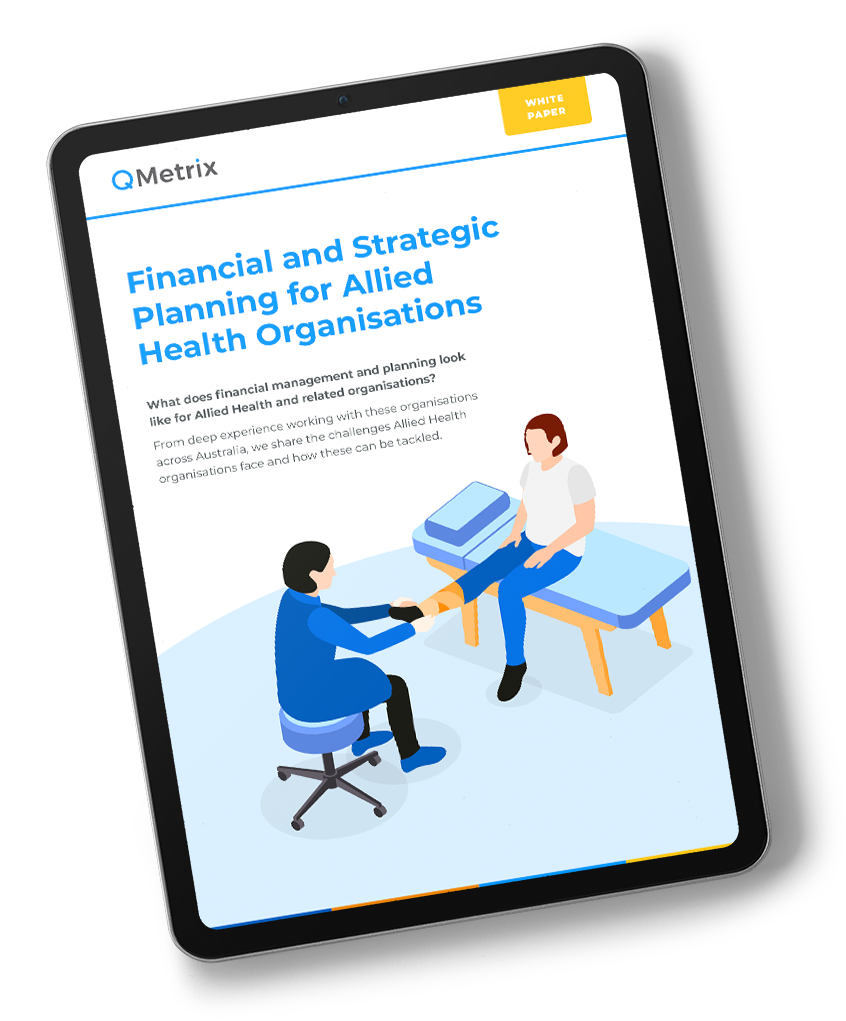
Financial and strategic planning for Allied Health organisations
How can finance teams navigate the complexities of financial planning in Allied Health and Aged Care organisations?
This whitepaper discusses the challenges, solutions, and role of finance.