
Before transforming their FP&A process, RightShip struggled with an unreliable network of 40 Excel spreadsheets that created operational bottlenecks across their global operations. Partnering with QMetrix, RightShip implemented Workday Adaptive Planning in just 8 weeks, empowering their international teams with real-time, self-service reporting.

RightShip is the maritime industry’s leading safety and risk intelligence platform. Operating worldwide, RightShip supports organisations in transforming complex maritime safety and operational risk into intelligence customers can act on with confidence.

The challenge: Navigating a sea of spreadsheets
Before embarking on their transformation journey, RightShip’s finance team relied on a web of 40 Excel spreadsheets, which was far too rudimentary for a global business operating in six countries.
To combat this, they introduced a new tool. However, it eventually proved inadequate for their complex operating model.
After two years, the team was still circulating spreadsheets, and budgeting and subscriptions planning remained reliant on Excel.
RightShip required a platform capable of handling complex multi-year plans and integrating diverse data streams.
They wanted a single source of truth to eliminate the need to send around files with different passwords.
The solution: Steering towards Workday Adaptive Planning
To source a more robust solution, RightShip ran a competitive process and ultimately selected QMetrix to implement Workday Adaptive Planning.
With QMetrix, they scoped out the first phase of the project, focusing on eliminating spreadsheets and configuring the planning models in Adaptive Planning.
They successfully took the solution from contract sign-off to go-live in a short eight weeks.

Establishing a single source of truth
In the early stages, there was a focus on profit and loss planning, and ensuring models were built for key areas such as headcount and payroll, and the subscription and inspection arms of the business.
Through access and security rules, department heads are only able to access what they need.
Financial processes are also more tightly governed. For instance, budgets can be permanently locked down on specific dates to enforce process and rigour.
Instead of navigating ad-hoc adjustments, management has absolute certainty that they are working with the approved plan.
Any adjustments can then be planned for and structured in the next budget or forecast.
Operational plans and measuring key metrics
RightShip has two core business areas – subscriptions and inspections. Their unique revenue streams require sophisticated modelling.
Previously, these were built in Excel with basic price-times-volume calculations, but could not capture customer growth and Annual Contract Value (ACV).
Through Workday Adaptive Planning, RightShip built an integrated subscription model with the ability to trace revenue figures by drilling down to the detailed assumptions in the ACV plan.
In addition, an inspections planning sheet serves as the benchmark for monthly volume and price expectations.
They also configured Adaptive Planning to ingest non-financial data directly from the RightShip platform, allowing the finance team to accurately measure profitability and related KPIs by specific product groups.

Complex global payroll and multi-year planning
Calculating pension schemes and CPI increases for a workforce spanning several countries used to be a tedious process for the finance team, but this is now seamlessly handled within Workday Adaptive Planning.
This, and other complex modelling for operations, have been included in a 5-year business plan, which allows RightShip to plan far ahead and with more certainty.
Global collaboration and self-service reporting
With automated daily actuals feeding directly into Workday Adaptive Planning from NetSuite, global business leaders enjoy true self-service capabilities.
A user in London can access and review their budget while the Australian finance team is asleep, eliminating time-zone barriers. Managers can autonomously drill straight down into individual transactions to investigate variances.
Consequently, month-end meetings have shifted away from tedious line-by-line explanations and transitioned into high-value, forward-looking strategic discussions about what the variances mean for future forecasts.
Automated reporting and corporate governance
By leveraging OfficeConnect, a Workday Adaptive Planning plugin, RightShip automated their month-end reporting, feeding actual and plan data directly into Excel and PowerPoint templates. This has reduced the reporting workload.
The tool’s strict, role-based security access has also eliminated the need to password-protect or email sensitive files.
Having all this information on hand proved invaluable when RightShip introduced a new investor.
The single source of truth allowed potential investors to easily gain historical figures and forecasts, providing them with trust in RightShip’s financial data.
Partnering for success with QMetrix
Having worked with QMetrix across multiple implementations, Rob highlights the partner’s disciplined approach to delivery.
“I have worked with QMetrix across several FP&A implementations and found them to be consistent and dependable. They are highly responsive, take time to scope things clearly, and bring experience from diverse Workday environments to share learnings which has been helpful for us.”
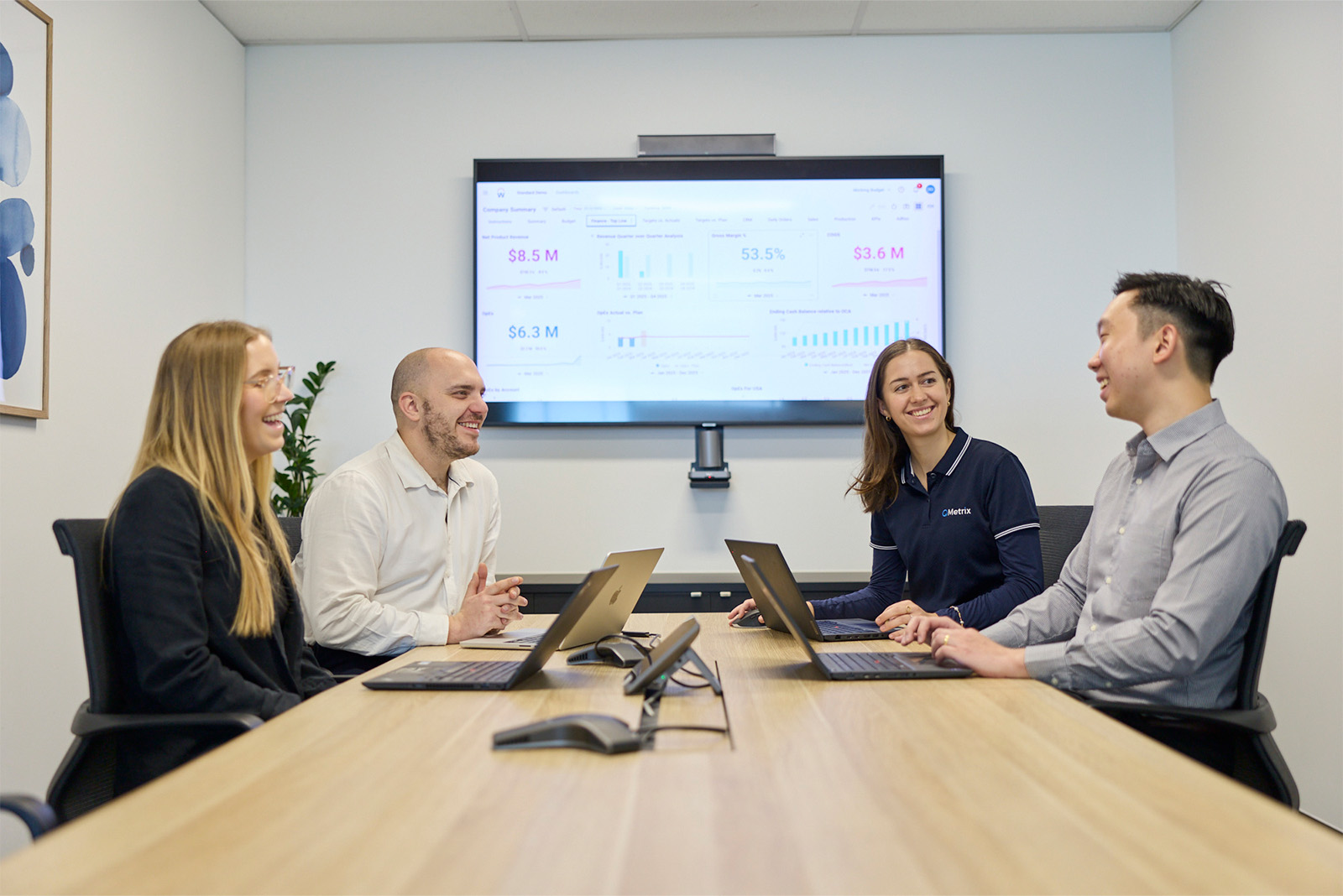
QMetrix collaborated closely with RightShip to thoroughly plan and scope out clear, manageable phases, and deploy as planned.

“QMetrix’s team has expanded through the years, and all throughout they have maintained a personalised approach. During the project, we know who our dedicated consultants are and can always reach someone for help”.
– Rob Stanley, Head of Financial Planning and Analysis
Key impacts and benefits for RightShip
Accelerate your FP&A with Workday Adaptive Planning
Workday Adaptive Planning helps finance teams with better Financial Planning and Analysis. Explore how it can solve your budgeting, forecasting, planning and reporting challenges.