
Singaporean telecoms leader StarHub faced operational bottlenecks and storage limits using a legacy planning tool and spreadsheets for budgeting. By partnering with QMetrix to implement a tailored Workday Adaptive Planning solution, StarHub eliminated version control issues, empowered 250 users with 24/7 self-service access, and enabled real-time executive reporting.

StarHub is a leading Singaporean telecommunications company that delivers communications, entertainment, and digital services for consumers and enterprises. StarHub ranks on the FORTUNE Southeast Asia 500 and is listed on the Singapore Exchange.

The challenge: Planning on a legacy system
Prior to modernising their systems, StarHub’s financial planning was constrained by their legacy tool, Anaplan. It had strict storage space limits, a lack of support, and an overly technical, code-heavy interface.
They also used Excel spreadsheets for budgeting and forecasting.
There were version control issues, high administrative burdens, long lead times, and things were especially problematic when finance team members changed.
Business unit owners also lacked visibility into their budgets and there were operational bottlenecks.
The solution: A connected, Workday Adaptive Planning ecosystem
To find a new solution, StarHub put out a Request for Tender (RFT), and went through a Proof of Concept (POC) process where several platforms were tested against StarHub’s pain points and objectives.
Eventually, Workday Adaptive Planning stood out as the best fit, and they chose QMetrix as the implementation partner due to their deep accounting acumen and hands-on communication style.
Together, StarHub and QMetrix designed a multi-instance Workday Adaptive Planning solution tailored to StarHub’s unique operational needs, changing how the company now handles Financial Planning and Analysis (FP&A).

Customised OPEX and CAPEX modelling
As a big telecommunications company which is constantly pivoting, standard, off-the-shelf financial models don’t work for StarHub.
They need fast-moving changes, require a detailed gross margin line, and CAPEX tracking throughout the project lifecycle – from PO creation and billing milestones to asset capitalisation upon project completion.
To solve this, QMetrix built a tailored model which allowed the finance team of 40 to easily push numbers down and run reports, while also locking down what 250 users could access or edit.
It balanced unique corporate requirements with a setup that is easier to consolidate, track and manage.
Tan Ling Jun, Assistant Vice President of Corporate Finance at StarHub says, “Our consultants at QMetrix have a lot of accounting and technical knowledge, so we saw eye to eye quickly. They spent time understanding our unique requirements and recommended solutions, detailing the pros and cons.”

“QMetrix know Adaptive Planning well and bridged the gap between what the system can do and what we needed. They proactively provided several ways of doing things and it brought us a lot of benefits. I found that to be a real difference between them and other vendors I have worked with”.
– Tan Ling Jun, Assistant Vice President of Corporate Finance
Empowered self-service and “train-the-trainer” support
One issue with the previous FP&A system was that it was code-heavy and complicated, making onboarding and self-service difficult.
Business unit owners couldn’t see their budgets, and had to wait for a finance business partner to find and share information.
To resolve this, StarHub used a “train-the-trainer” approach, upskilling a core group of finance partners into power users who can build reports and modify model sheets independently.
To ensure smooth adoption by their large base of 250 users, QMetrix worked with StarHub to intentionally name dimensions and attributes intuitively and create a glossary “cheat sheet” to help define and build reports consistently.
Power users can now take requirements and make changes to input sheets to customise reporting consoles according to each business unit’s requirements, within a pre-defined structure. Any complex issues are escalated to an internal administrator or QMetrix.
Ling Jun reports that the adoption rates have been high. Managers realised that 24/7 self-service access was better than waiting on finance for answers.
This has improved turnaround times and overall business ownership, communications, and clarity of numbers as they know which single version to refer to.
The training provided by QMetrix has also enabled the StarHub team to self-sufficiently manage Workday Adaptive Planning in-house.
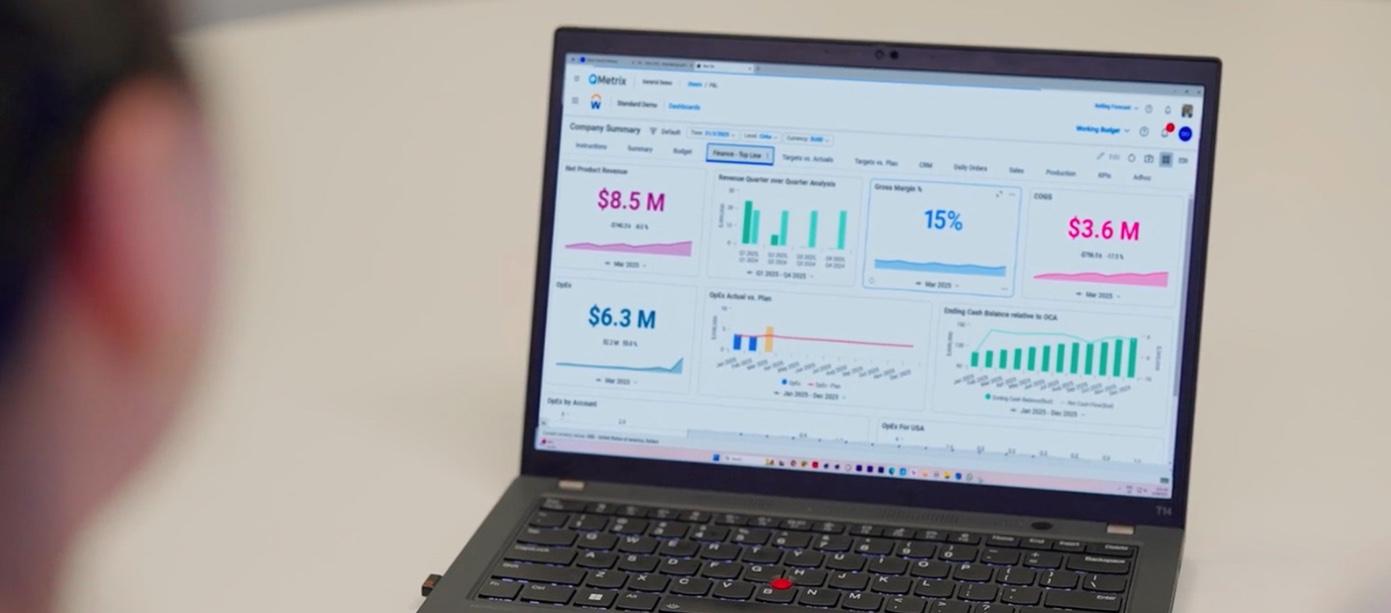
Interactive executive dashboards
Reporting for senior leadership used to be a time consuming effort pulling numbers into static PowerPoint decks and Excel sheets. It meant a delay between data updates and final reports.
With Adaptive Planning, StarHub built interactive dashboards which the executive team can access themselves.
The team no longer needs to prepare and distribute slide decks for routine executive reporting.
Instead, the team can just click refresh and add commentary, and the CFO can obtain the latest information directly, making access to insights and decision-making much faster.
Targeted multi-instance architecture
To eliminate storage and data-segregation challenges of the past, StarHub deployed three interconnected instances that function in a parent-child relationship.
Firstly, they have the main instance which is the central hub for all budgeting and forecasting, corporate and management reporting, and board decks.
The second instance is for workforce management and is managed by the HR team. This instance handles granular forecasting and budgeting for manpower related costs, including multi-currency considerations. It keeps selected details locked and secure, only for the HR team to access.
The third instance is the Enterprise Business Group instance, which captures customer databases for the enterprise sales division and tracks revenue across various sales pillars, channels and needs.
This enables each division to plan separately and securely, while final data gets pushed back to the main instance at specific time periods for overall planning purposes.

Partnering for speed and success
Ling Jun says Adaptive Planning is easy for finance professionals to use, and she appreciates how it constantly has new releases to improve the product.
She attributes the project’s success to the direct, collaborative relationship they had with QMetrix. StarHub purposefully chose a company of their size to avoid bureaucratic layers and red tape often associated with bigger consultancies.
“What I really appreciate about QMetrix is their clear communication, from leadership all the way to the consultants.”
“When we had a problem, we would speak directly to the team working on the project and they would resolve things quickly. We didn’t waste time going through layers of project management to get heard; I never had to pass a message twice, and it was always translated clearly,” says Ling Jun.
“QMetrix’s transparent communication and proactive approach allowed us to make rapid progress and complete the implementation within a short timeframe, optimising resources on both sides. They take genuine accountability and ownership of their work, and balance professional delivery with an agile approach”.
– Tan Ling Jun, Assistant Vice President of Corporate Finance
Key impacts and benefits for StarHub
Accelerate your FP&A with Workday Adaptive Planning
Workday Adaptive Planning helps finance teams with better Financial Planning and Analysis. Explore how it can solve your budgeting, forecasting, planning and reporting challenges.