
To address inefficient manual reporting and messy Excel-based budgeting, Bevilles partnered with QMetrix to implement Workday Adaptive Planning. This solution streamlined their financial processes through automated data integration and store-level reporting, providing the leadership team with accurate, granular insights to drive agile scenario modelling and strategic growth.

For over 85 years, Bevilles has been bringing Australians a range of jewellery and watches to make every customer feel good about themselves. It is a third generation family owned Australian company with 26 stores in Victoria, New South Wales and South Australia.

Bevilles’ challenge: Cluttered spreadsheets and inefficient reporting
Bevilles used to do budgeting and planning on a lot of messy Excel spreadsheets. It was impossible to reconcile management accounts and difficult to achieve error free reporting.
The leadership team were unable to get accurate reporting by store, and it took a long time to produce reports which ultimately delivered unreliable results. A lot of time was spent just trying to pull Excel reports together, leaving no time to analyse the results.
This had to change.
Bevilles set about looking for a different solution and decided on Workday Adaptive Planning for these key reasons:
- The solution was purposefully built – and useful for finance
- It allowed depth of planning at the granularity needed
- It provided a single source of truth for budgets, actuals and scenarios
- It required very little IT support and was mostly self-service
After implementing Workday Adaptive Planning, Bevilles was able to solve the challenges of manual Excel reporting, but also enhanced the reporting further through being able to drill down on reports to manage business performance by store while also giving management a better overview of the business.
After several years, as the business grew and changed and their initial implementation partner was no longer available to assist, Bevilles decided to re-evaluate if Workday Adaptive Planning could still meet their needs.

The solution: Ensuring best practice and ease of use
After discussions with QMetrix, Robert Derman, Chief Financial Officer at Bevilles, decided to continue with Workday Adaptive Planning.
Together with QMetrix, Bevilles enhanced several areas in Workday Adaptive Planning so the models and planning capability would continue to serve the business as it evolved. To do this, QMetrix developed a deep understanding of Bevilles’ instance in order to troubleshoot and improve on it.
One key enhancement was to determine how the planning system could reflect operations accurately. For example, how costs and revenue are impacted when a store is open or not, based on direct or indirect costs, and fixed or movable costs.
Having this kind of granularity and accuracy helps Bevilles understand the outlook of the business, which in turn helps them make informed decisions. Importantly, the models themselves are continually reviewed to ensure they serve their purpose, without becoming unnecessarily complex.
At the same time, the Bevilles’ team have skilled up and can own and manage the solution internally, and only call on QMetrix for occasional assistance.
Integrating source systems for planning
Having timely and accurate planning requires data to flow seamlessly from source systems into the planning system to provide the necessary baseline to work from.
Bevilles leveraged QMetrix’s team of data integration experts to integrate financial data from the General Ledger as well as daily sales data by store. The scheduled integration tasks run automatically on a daily basis in the background, and improve the efficiency of both reporting and planning in Workday Adaptive Planning.
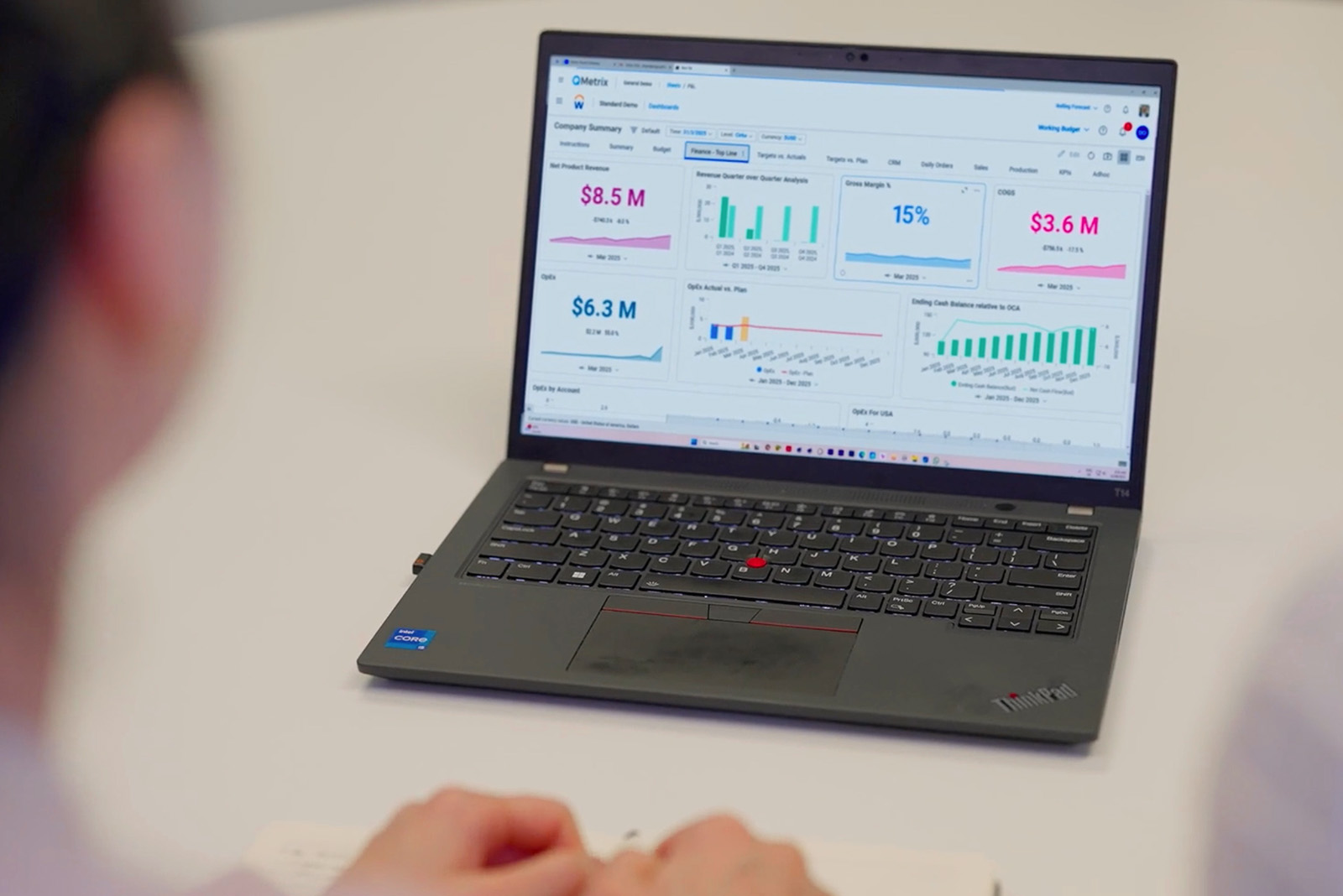
Scenario planning with flexibility and granularity
As a retail business, store level planning is a key factor in the budgeting and forecasting process. Bevilles needs to understand how each store is performing and how that impacts the business as a whole. With Workday Adaptive Planning, they are able to quickly plan on an individual store level and help store managers evaluate and improve on store performance.
As a forward looking business, Bevilles is constantly exploring a variety of growth strategies. In Workday Adaptive Planning, these strategies are very easy and quick to model.
The finance team are able to understand the cash flow requirement based on assumptions; Workday Adaptive Planning breaks it all down based on historical data and various forward-looking assumptions, and enables multiple scenarios to be run quickly so they can analyse and make strategic decisions.
Another important factor for retail stores is managing inventory. Workday Adaptive Planning helps Bevilles manage its effective working capital and business capital through modelling inventory holdings and purchases. A 3-way integrated model with profit and loss, cashflow and balance sheet enables them to evaluate and decide how much inventory they need and can hold at any point in the future.
Easy and quick scenario modelling in Workday Adaptive Planning allows management to see the financial impacts of potential events, so they can take pre-emptive action or course correct with agility.

Labour planning within Adaptive
Sales are dependent on seasonality. This affects how stores are staffed and the associated labour cost of staffing.
Bevilles can break labour costs down by store on a fortnightly basis to provide a wage budget per store which is predicted based on trends in previous years. This enables the Human Resource team to manage labour at a store level and effectively control wage costs as a result.
During the years where the COVID-19 pandemic hit hardest, stores did not operate as usual. To cater for this, Workday Adaptive Planning had the flexibility to build logic which allow Bevilles to look back at trending data from the three years before the pandemic.
Being able to accommodate such adjustments in Workday Adaptive Planning means Bevilles has more objective data on which to base their labour planning.
An easy system that can be operated independently
The Bevilles team are familiar with many functions in Workday Adaptive Planning and had been running it themselves. However, they chose to work with the QMetrix team who had up-to-date and broad experience, to ensure they were following best practice, and to enhance their own skills.
Robert Derman, Chief Financial Officer at Bevilles says, “QMetrix has excellent knowledge of Workday Adaptive Planning. They have worked with so many different clients so they have a lot of knowledge of the solution. We see them as extra support and their consultants provide add-on value to what we already know.
They always demonstrate knowledge on the latest product releases and features and know how to use them best. It really does help us adhere to best practice and keep the models clean. This means it doesn’t get complicated and remains easy to use.”

“Through working with QMetrix, our knowledge of Workday Adaptive Planning has been built up. This means we are not completely reliant on QMetrix, and have become even more self-sufficient in our use of the system.”
– Robert Derman, CFO
Impact for Bevilles

Scaling the storefront with Workday Adaptive Planning
Workday Adaptive Planning helps finance teams with better Financial Planning and Analysis. Explore how it can solve your budgeting, forecasting, planning and reporting challenges.